
Wondering about the right CPT for colposcopy.
Finding your way through medical billing can feel like trying to read a map in the dark, especially when dealing with complex gynecological evaluations. If you want to keep the revenue flowing while keeping your head above water, mastering the specific codes for cervical and vaginal examinations is absolutely crucial.
We are going to break down the most essential details of what is the correct cpt for colposcopy in a completely straightforward, casual conversation today. No overly dense academic jargon or robotic lectures here. Instead, we will look at how a simple colposcopy with biopsy cpt or a cervical biopsy setup can keep your medical billing system running smoothly.
We will also touch on how code requirements function today and how things compare when removing polyps. Let us dive right in and look at the actual numbers you need to use daily to keep your claims clean and get paid without the usual administrative headaches that plague so many practices.
Why Gynecological Procedure Billing is a Different Kind of Beast
If you have spent any time dealing with medical billing, you already know that every specialty has its own quirks. Gynecology is uniquely challenging because a single office visit often combines cognitive discussions, visual examinations, and quick surgical procedures like taking tissue samples or removing growths.
If you do not document these elements with extreme precision, insurance companies will happily deny your claims. They love to claim that your procedures are bundled or that you lacked the medical necessity to perform them in the first place.
To win this game, you need to understand the exact structure of the coding system and how to show your work in the clinical chart. Let us walk through the core code groups so you can build a bulletproof billing workflow.
The Core Coding Families in Colposcopy and Cervical Procedures

When we talk about colposcopy, we are looking at a highly specific set of codes located in the female genital system section of your coding book. These range from simple visual examinations of the cervix to procedures that involve biopsies, endocervical curettage, or polyp removals. To keep the billing workflow smooth, knowing which code covers which specific anatomical site is half the battle.
To make this incredibly easy to scan, we have organized the primary colposcopy and cervical procedure categories into a clean, simple layout.
| Code Category | CPT Code | Primary Clinical Use |
| Simple Colposcopy | 57452 | Visual examination of the cervix, including upper vagina |
| Colposcopy with Biopsy | 57454 | Colposcopy with biopsy of the cervix and endocervical curettage |
| Colposcopy with Cervical Biopsy | 57455 | Colposcopy with single or multiple biopsies of the cervix only |
| Colposcopy with ECC | 57456 | Colposcopy with endocervical curettage only |
| Loop Electrode Excision (LEEP) | 57522 | Conization of cervix, including loop electrode biopsy |
| Cervical Polyp Removal | 57500 | Biopsy of cervix or local excision of cervical lesion or polyp |
| Biopsy of Uterus/Endometrium | 58100 | Endometrial sampling or biopsy without cervical dilation |
| Vaginal Colposcopy | 57420 | Visual examination of the vagina using a colposcope |
Breaking Down the Cervical Visual Exam Codes
Every single procedure starts with a clear visual assessment. When a patient has an abnormal Pap smear, they are usually scheduled for a colposcopy. This allows the provider to inspect the cervix under high magnification to locate any abnormal cells.
Standard Colposcopy of the Cervix
These are your everyday baseline codes. You will choose them based on whether you are simply looking at the cervix or taking tiny tissue samples from different areas of the pelvic anatomy.
- 57452: This is the basic colpo cpt code. It represents a simple visual examination of the cervix, which may include the upper vagina. You cannot bill this code if you perform any type of biopsy, curettage, or surgical intervention during the same session.
- 57454: This is a highly popular option in busy clinics. This represents colposcopy with biopsy of the cervix and endocervical curettage. This single code bundles both the cervical tissue sampling and the scraping of the inner canal of the cervix.
- 57455: This represents colposcopy with biopsy of the cervix only. You use this code when you take one or more outer cervical biopsies but do not perform an endocervical curettage.
- 57456: This is colposcopy with endocervical curettage (ECC) only. You use this when you scrape the inner lining of the cervical canal but do not take any tissue samples from the outer face of the cervix.
Using a dedicated colpo cpt code properly can make a massive difference in your medical billing revenue, as these codes carry solid relative value units. However, you have to be highly careful because if you mix up these codes, insurers will audit your charts to verify exactly where the biopsies were taken.
What is CPT Code 57454? Let us Look at the Details
To really understand the system, we need to look at what the 57454 cpt code covers. By definition, this code is used when a provider performs a colposcopy of the entire cervix and takes both an outer cervical biopsy and an endocervical curettage during the same setting.
This is often referred to as the ultimate combined diagnostic code for abnormal cervical findings.
The Key Requirements for 57454
For a clinical encounter to qualify for cpt code 57454, your documentation must clearly support two distinct surgical actions:
- Cervical Biopsy: The provider must physically remove a small piece of tissue from the outer surface of the cervix, usually targeting areas that turn white after applying acetic acid.
- Endocervical Curettage: The provider must use a small instrument called a curette to scrape cells from the inner lining of the cervical canal.
If you only perform one of these actions, you cannot bill 57454. For example, if you only perform the outer biopsy, you must use 57455. If you only perform the scraping of the canal, you must use 57456. Accurate billing requires matching the exact clinical actions to the correct code in the book.
Cervical Polyp Removal Coding Guidelines
During a routine colposcopy, providers often discover additional growths on the cervix, such as polyps. When a physician decides to remove these growths, the billing rules can become slightly confusing.
Understanding CPT Code for Cervical Polyp Removal
If you discover a polyp and remove it, you are stepping into a different code family.
- 57500: This is the standard cpt code cervical polyp removal option. It covers a biopsy of the cervix or local excision of a cervical lesion, which includes the removal of a cervical polyp.
- cpt 57520: This represents conization of the cervix, which is a much larger surgical procedure. It involves removing a cone shaped wedge of tissue from the cervix using a cold knife, laser, or electrosurgical technique.
Can You Bill Cervical Polyp Removal and Colposcopy Together?
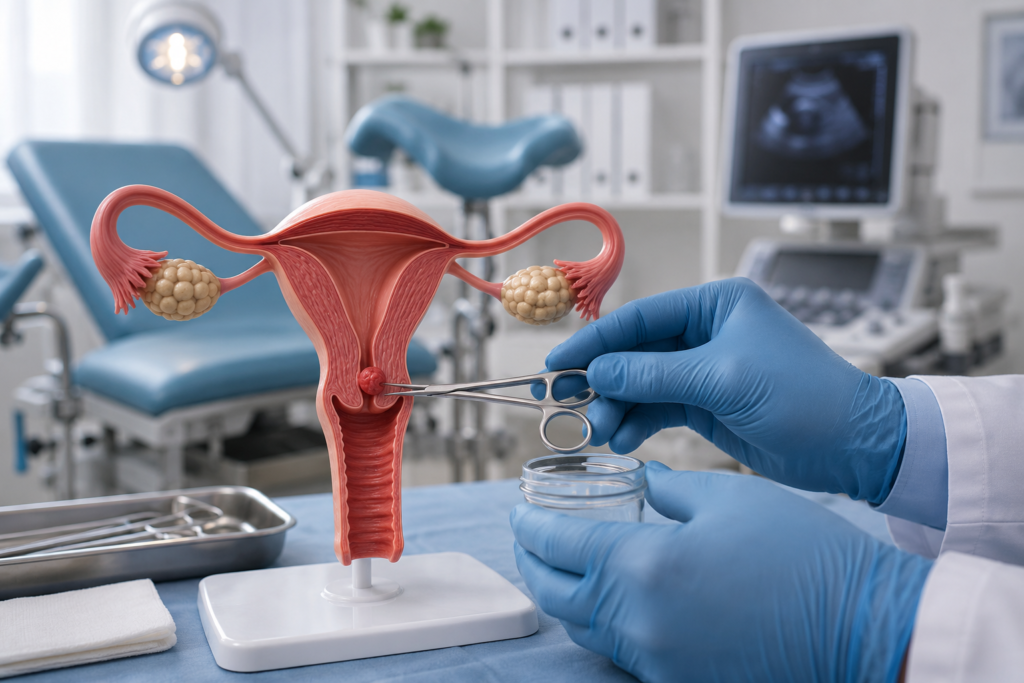
This is a classic question in medical billing. If a provider performs a colposcopy and then decides to remove a cervical polyp during the same visit, can you bill both?
Yes, but you must follow the correct grouping guidelines. If you perform a simple colposcopy to identify the polyp and then remove it, you can bill:
- 57500 for the polyp removal.
- 57452 for the colposcopy, but you must append Modifier 51 (multiple procedures) or Modifier 59 (distinct procedural service) depending on individual payer preferences.
However, if you are performing a colposcopy with a standard biopsy of the cervix and also happen to snip off a small polyp, payers will often bundle the polyp removal into the overall colposcopy with biopsy cpt code. Always check individual insurance contracts to see how they handle same day surgical edits.
Deep Dive: Comparing Colposcopy Codes to Protect Your Claims
To fully establish our clinical authority, we need to understand how different colposcopy codes compare to other options that appear on your daily claim sheets. Let us look at a few common points of comparison.
57454 vs 57455: The ECC Distinction
This is a major source of billing errors. Both codes represent a colposcopy with biopsy, but the difference lies entirely in the endocervical canal evaluation.
- 57454: Covers BOTH the outer cervical biopsy and the inner endocervical curettage.
- 57455: Covers ONLY the outer cervical biopsy. No scraping of the inner canal is performed.
Because 57454 involves more work and multiple tissue samples, it carries a higher reimbursement rate. If your provider routinely writes “colposcopy with biopsy and ECC” in the chart, but your billers accidentally submit 57455, you are losing valuable revenue on every single claim.
The Contrast with Vaginal and Vulvar Colposcopies
Sometimes, the abnormal cells are not on the cervix at all. If the provider needs to inspect the vagina or the external vulva using the scope, you must use completely different code sets.
- 57420: Colposcopy of the entire vagina, including the upper vaginal vault.
- 57421: Colposcopy of the vagina with biopsy.
- 56820: Colposcopy of the vulva (the external female genitalia).
- 56821: Colposcopy of the vulva with biopsy.
Mixing up cervical colposcopy codes with vaginal or vulvar codes is a massive compliance risk. Always make sure your clinical documentation clearly states the exact anatomical site that was evaluated and biopsied.
How to Document a Colposcopy Encounter for Audit Protection
The ultimate defense against insurance clawbacks is robust, detailed clinical documentation. When an auditor looks at your charts, they want to see a clear story that explains exactly why every single service was performed.
Let us look at a simple, compliant template you can use to document a colposcopy with biopsy visit.
57454 Documentation Template
Procedure: Colposcopy with Cervical Biopsy and Endocervical Curettage (ECC)
Indication: High risk HPV positive with atypical squamous cells of undetermined significance (ASC-US) on recent screening.
Description of Procedure: The patient was placed in the dorsal lithotomy position. A speculum was inserted, and the cervix was fully visualized. A 5% acetic acid solution was applied to the cervix.
Under colposcopic examination, the transformation zone was fully visible (satisfactory colposcopy). An area of dense acetowhite epithelium with fine punctation was noted at the 12 o’clock position on the squamocolumnar junction.
A biopsy was taken from this 12 o’clock lesion using Tischler biopsy forceps. Next, an endocervical curettage was performed using a Kevorkian curette. Hemostasis was achieved immediately using Monsel solution.
Specimens Obtained:
- Specimen A: Cervical biopsy from 12 o’clock position.
- Specimen B: Endocervical curettage scrapings.
Patient Tolerance: The patient tolerated the procedure well with minimal cramping and was discharged in stable condition.
This clinical note is simple, clear, and perfectly supports a 57454 claim by explicitly documenting both the cervical biopsy and the endocervical curettage.
Vital Medical Billing Guidelines for Clean Claims

Getting paid on time is the goal of any medical billing department. To keep your claim denials low, you need to follow specific billing guidelines that insurers look for when scanning your clinical notes.
Avoid Common Same-Day Office Visit Traps
One of the most common mistakes in gynecology billing is trying to bill a standard office visit alongside a colposcopy. If a patient comes in specifically for a scheduled colposcopy, you cannot bill an Evaluation and Management code (like 99213 or 99214) unless the patient has a separate, completely unrelated clinical issue on the same day.
If they complain of a brand new, unrelated symptom (like a severe sinus infection) and you evaluate that issue during the same visit, you can bill the office visit. However, you must append Modifier 25 to your office visit code and make sure your clinical notes for the sinus infection are completely separate from your colposcopy procedure notes.
Document the Visualization of the Transformation Zone
When performing a colposcopy, the provider must document whether the transformation zone (the area where abnormal cells are most likely to grow) was fully visible.
In your clinical notes, always write whether the colposcopy was “satisfactory” (meaning the transformation zone was fully seen) or “unsatisfactory” (meaning the zone could not be fully visualized). This detail is highly important for justifying the medical necessity of any follow up procedures.
Watch Out for Pathology Bundling
When you submit a colposcopy claim with multiple specimens, make sure your laboratory billing is aligned. The lab will bill for the professional interpretation of the biopsy tissues using CPT code 88305 (level IV surgical pathology).
Since 57454 involves two specimens (the cervical biopsy and the ECC scrapings), the lab should bill 88305 twice. Make sure your clinic documentation clearly lists both specimens so the pathology claims match your surgical claims perfectly.
Standardizing the Colposcopy Billing Workflow
To make sure your medical billing team never misses a step, it is highly helpful to establish a standard coding protocol. This reduces confusion and ensures that clinical providers and billers are completely on the same page.
[Patient Arrival]
       │
       ▼
[Verify Prior Authorization] (Confirm if the payer requires approval for colposcopy)
       │
       ▼
[Procedure Performed] ──► [Determine Anatomical Site] (Cervix, Vagina, or Vulva)
       │
       ▼
[Identify Surgical Actions]
       ├── Cervical Biopsy + ECC ─────────────► [Bill 57454]
       ├── Cervical Biopsy Only ──────────────► [Bill 57455]
       ├── Endocervical Curettage Only ───────► [Bill 57456]
       └── Simple Exam (No Biopsy) ───────────► [Bill 57452]
       │
       ▼
[Polyp Found and Removed?]
       ├── Yes ──► [Bill 57500] ──► [Append Modifier 51 or 59 based on contract rules]
       └── No ───► [Proceed with standard colposcopy billing]
       │
       ▼
[Document Transformation Zone & Specimens] (Label each tissue container clearly in the chart)
       │
       ▼
[Link Clinical ICD-10 Diagnosis Codes] (e.g., abnormal pap smear, high risk HPV)
       │
       ▼
[Submit Claim for Review]
Navigating Pre-Authorizations in Gynecological Billing
One of the biggest hurdles in modern medical billing is dealing with pre-authorization requirements. Insurers are notoriously strict when it comes to advanced testing and outpatient surgical procedures.
Which Procedures Require Prior Authorization?
As a general rule, standard office visits do not require prior authorization, but specialized procedural tests often do. You will want to verify authorization requirements for:
- Repeat Colposcopies: If a patient has multiple colposcopies within a short period, insurers will want to verify why a repeat procedure is clinically necessary before they agree to pay.
- LEEP Procedures (57522): Because Loop Electrode Excision involves surgical conization of the cervix, most commercial plans require prior authorization to verify that conservative management options have failed.
- Anesthesia Services: If your practice performs colposcopies or diagnostic excisions under deep sedation in an outpatient surgery center, you must secure prior authorization for both the facility fee and the anesthesia services.
If you submit a claim for these services without securing an approved authorization number beforehand, the claim will be denied automatically. Getting these cleared before the patient sits in the exam chair is the single best way to keep your practice revenue healthy.
Summary of Essential Colposcopy Coding Rules
To help your billing team keep these rules top of mind, here is a quick reference table of the most critical coding rules we have covered:
| Clinical Scenario | Correct Coding Action | Avoid This Common Mistake |
| Colposcopy with outer biopsy + ECC | Bill 57454 | Billing 57455 and 57456 together, which is considered unbundling |
| Colposcopy + Same-Day unrelated E/M | Append Modifier 25 to the E/M code | Billing the office visit without a modifier, which causes an automatic denial of the visit |
| Simple Colposcopy (Visual only) | Bill 57452 | Billing 57454 when no physical biopsies were actually taken |
| Removal of Cervical Polyp | Bill 57500 | Billing 57520, which represents a much larger cone biopsy procedure |
| Colposcopy of Vaginal Vault | Bill 57420 or 57421 | Using cervical codes like 57452 for evaluations of the vaginal canal |
Building a Resilient Billing Team
At the end of the day, masterfully handling cpt for colposcopy is not just about memorizing numbers. It is about building a cohesive workflow where your clinical providers, front desk staff, and medical billing specialists are all communicating constantly.
When your front desk team knows exactly which insurance plans require prior authorization for gynecological procedures, they can prevent patients from scheduling tests that will not be paid for. When your doctors understand how their procedure notes impact the selection of a colposcopy cpt code, they will write more detailed, audit-proof charts. And when your billing specialists know the difference between a cervical biopsy and a vaginal biopsy, they will submit highly accurate claims that get paid on the very first try.
Invest the time to train your team on these guidelines, keep your templates updated, and you will see your denial rates drop while your practice revenue steadily grows.
Frequently Asked Questions
What is the most common cpt code for colposcopy with a biopsy and ECC?
The most frequently used code for this combined procedure is CPT code 57454. It represents a colposcopy of the cervix with both a cervical biopsy and an endocervical curettage performed during the same session.
Can you bill CPT code 57500 alongside a standard colposcopy code?
Yes, you can bill CPT 57500 for cervical polyp removal alongside a colposcopy code, but you must append Modifier 51 or Modifier 59 depending on individual payer contracts. Be sure your documentation clearly separates the polyp removal from the colposcopy findings.
What is the difference between CPT code 57454 and CPT code 57455?
CPT 57454 covers both an outer cervical biopsy and an endocervical curettage (ECC). CPT 57455 covers only the outer cervical biopsy, with no scraping of the inner endocervical canal performed during the procedure.
Is a simple colposcopy billed separately if a biopsy is performed?
No. If a biopsy is performed during the colposcopy, the simple visual code 57452 is completely bundled into the surgical codes like 57454 or 57455. You must only bill the appropriate biopsy code.
When should you use CPT code 57522 instead of a simple biopsy code?
CPT 57522 is used for a Loop Electrode Excision Procedure (LEEP) or conization of the cervix. This is a therapeutic surgical procedure to remove a larger, cone shaped piece of the cervix, whereas simple biopsy codes are used for smaller diagnostic tissue sampling.