
Navigating the complex DME CPT codes framework does not have to be difficult
Navigating the compliance landscape for providing physical support devices to patients can often feel like an endless maze. When you want to ensure your healthcare practice remains financially healthy while delivering essential home supplies, understanding how to apply the correct DME CPT codes becomes an absolute top priority.
If you process claims for items like wheelchairs, oxygen concentrators, or orthotics daily, you know that missing minor administrative details causes immediate denials. We are going to walk through the real world mechanics of how specialized coding works, how providers choose specific alphanumeric representations, and how policy adjustments reshape your revenue cycle today.
Let us demystify the system so your administrative team can handle equipment claims with confidence and avoid expensive billing errors.
Why Equipment Billing Requires Special Administrative Expertise
Most healthcare services utilize the standard five digit numerical coding system to describe physical procedures or evaluations. However, when dealing with physical supplies that patients take home, the entire operational framework shifts.
If your team manages these lines of service, you have to transition into a completely different system managed by the federal government. Insurance carriers look at these claims under a microscopic lens because the risk for overutilization and fraud is historically high.
To keep your operations running seamlessly, let us look at the distinct code families and map out how you should organize your incoming orders.
Core Code Mapping for Durable Medical Equipment and Supplies
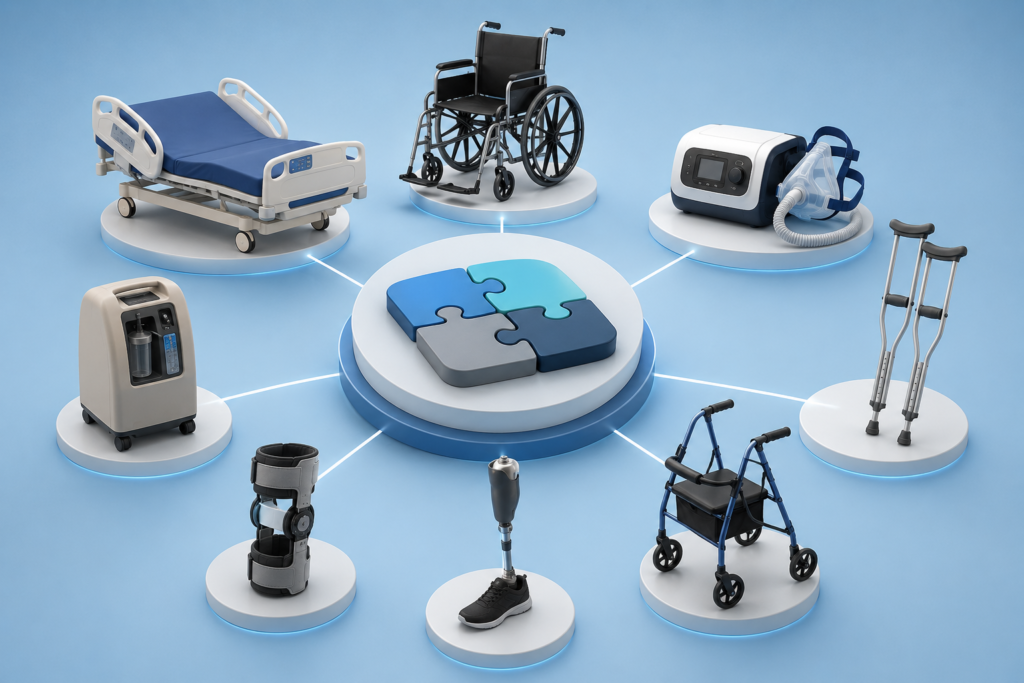
When a patient receives physical support equipment, the item must be categorized according to its primary functional purpose. To help you visualize how these tracking letters are grouped, we have outlined the core structural sections in a clean, easy to scan table layout.
| Equipment Category | HCPCS Alphanumeric Range | Primary Equipment Covered |
| Medical and Surgical Supplies | A4206 to A8004 | Incontinence items, diabetic test strips, needles, splints |
| Enteral and Parenteral Therapy | B4034 to B9999 | Feeding tubes, nutritional solutions, infusion pumps |
| Durable Medical Equipment Base | E0100 to E8002 | Hospital beds, standard wheelchairs, oxygen concentrators |
| Temporary Codes for MACs | K0001 to K0903 | Specialized wheelchair accessories, advanced mobility parts |
| Orthotic and Prosthetic Devices | L0112 to L9900 | Spinal braces, knee orthoses, artificial limbs |
The Alphanumeric System: HCPCS vs CPT for Supplies
One of the first major concepts you must master in dme coding and billing is that the terms used by traditional providers can sometimes lead to confusion. People frequently search for a specific cpt code durable medical equipment option, but in actual execution, the American Medical Association coding manual contains very few direct codes for physical objects.
Instead, the industry relies heavily on the Healthcare Common Procedure Coding System, which provides the precise alpha numeric values needed for payment.
Understanding the Role of Level II Coding
When you look at a dme code, you will notice it always starts with a single letter followed by four numbers. This is a Level II national code.
- The E Code Group: This represents the classic durable medical equipment hcpcs codes category. If a device can withstand repeated use, primarily serves a medical purpose, and is useful only in the event of an illness or injury, it will live here. Think of items like an E0143 for a folding wheeled walker.
- The A Code Group: People often ask if durable medical equipment are hcpcs a codes exclusively. The answer is no, because the A group primarily represents disposable medical and surgical supplies, like catheter bags or wound dressings, though it does include some specialized support items.
If you mistakenly search for these items inside a standard therapeutic manual instead of utilizing specialized dme hcpcs codes, your clearinghouse will reject the transmission before it ever reaches the claims processor.
Breaking Down Service Codes in Equipment Management
While the physical item itself requires an alphanumeric representation, the clinical team still performs human services surrounding that device. This is where actual service related dme medical coding intersects with traditional tracking.
Essential Service Related CPT Identifiers
When a physical therapist, occupational therapist, or physician spends time working with a patient to configure a complex device, you will utilize specific service identifiers.
- 97760: This represents orthotic management and training. You report this code for the initial encounter where a clinician fits, adjusts, and trains a patient on how to utilize a custom brace or spinal support.
- 97762: Use this option when a patient returns for a checkout session to ensure their established orthotic or prosthetic device is still functioning correctly without causing tissue damage.
- 94660: This covers the initiation and management of continuous positive airway pressure therapy. It tracks the human service of setting up the machine and teaching a patient how to use it, separate from the physical CPAP unit itself.
Balancing the service identifier alongside the physical equipment tracking requires clean documentation to ensure you do not inadvertently bundle the provider labor into the equipment cost.
Navigating the Capped Rental Framework
Unlike standard clinic encounters where a service is performed and billed once, equipment management involves long term usage logistics. The federal government classifies many high cost items under a capped rental structure.
To process these clean lines of revenue, you must master the rental progression rules.
The Capped Rental Month Indicators
When an item like a hospital bed or a patient lift is delivered, you cannot simply bill the full purchase price immediately. You must track the item across a multi month timeline using specific modifiers.
- Modifier KH: This must be appended to the alphanumeric identifier during the very first month of the equipment rental.
- Modifier KI: You apply this modifier during the second and third months of the continuous rental cycle.
- Modifier KJ: This tracks the remaining duration of the rental, spanning from the fourth month all the way through the thirteenth month.
Once a patient reaches the thirteenth month of continuous rental, the ownership of the device officially transfers to the beneficiary, and your monthly rental billings come to an end. If your billing software fails to advance these modifiers automatically as the months progress, the insurance system will deny the lines for consecutive identical submissions.
Analyzing Important Policy Updates and News
To run an efficient operation, your leadership must track updates published in AMA CPT news and official updates from the Centers for Medicare & Medicaid Services. The rules governing supplier numbers and documentation rules change constantly. Let us look at the current trends shaping the operational landscape.
Prior Authorization Expansion
The biggest modern challenge in managing these workflows is the ongoing expansion of the prior authorization master list.
- High Cost Item Focus: Regulatory bodies have placed intense focus on categories like custom power mobility devices, advanced respiratory ventilators, and continuous insulin infusion pumps.
- Pre-Delivery Requirements: If an item appears on the master list, you must submit every piece of clinical documentation to the payer and receive an affirmative authorization number before the item is delivered to the home. Delivering a device without this approval means your practice will absorb the entire financial loss.
Heightened Audit Focus on Face-to-Face Encounters

Payers have significantly stepped up their retrospective audits, looking closely at the initial physician evaluation. Regulations mandate that the ordering practitioner must conduct a face to face clinical encounter with the patient within a fixed timeframe before signing the equipment order. The note must explicitly state the exact physical limitations that make the device an absolute medical necessity for daily living.
Essential Documentation Templates for Audit Defense
The only way to survive a post payment review by a recovery audit contractor is to maintain ironclad documentation. Your records must tell a complete story that links the clinical limitation directly to the equipment design.
Let us look at a clean, compliant layout you can use to structure your internal intake files.
Standard Mobility Device Documentation Template
Clinical Evaluation Date: October 12, 2026
Ordering Practitioner: Dr. Clara Owens, MD
Equipment Requested: Standard Lightweight Folding Wheelchair (HCPCS E1240)
Mobility Limitation Assessment: The patient presents with severe osteoarthritis of both knees and progressive neurological weakness. The patient is completely unable to ambulate safely within the home environment due to a high fall risk and severe shortness of breath after walking less than ten feet.
Functional Home Needs: The patient resides in an accessible apartment with doorways wide enough to accommodate a standard chair. The patient possesses sufficient upper body strength and cognitive capacity to propel the manual wheelchair independently to accomplish basic activities of daily living, such as accessing the bathroom and kitchen area. Less supportive ambulatory aids, including a standard cane and a rolling wheeled walker, were trialed but failed to provide sufficient stability to prevent frequent falls.
Face-to-Face Encounter Confirmation: I personally evaluated the patient during a face to face visit today and confirmed that the mobility deficit cannot be resolved by conservative medical management alone. The requested equipment is medically necessary for daily functional independent living inside the home.
An intake file that features this level of specific, home focused detail will easily pass an insurance review because it explicitly eliminates lesser devices and justifies the medical need.
Mapping the Durable Medical Equipment Workflow
To ensure your billing team handles every single equipment request without experiencing preventable delays, it is highly beneficial to install a standardized operational progression.
[Physician Generates Equipment Order]
                 │
                 ▼
[Review Alphanumeric Assignment] (Cross-reference hcpcs dme codes for the exact device model)
                 │
                 ▼
[Check Payer Prior Authorization List]
         ├── Item Requires Approval ──► [Submit Clinical Notes to Payer] ──► [Secure Auth Number]
         └── Item Exempt ─────────────► [Proceed Direct to Delivery Coordination]
                 │
                 ▼
[Obtain Signed Face-to-Face Note] (Confirm the provider note explicitly details home mobility limits)
                 │
                 ▼
[Execute Equipment Delivery] ──► [Collect Signed Proof of Delivery] (Must feature date and signature)
                 │
                 ▼
[Determine Billing Method]
         ├── Purchase Option ────────► [Apply Modifier NU]
         └── Rental Framework ───────► [Identify Current Month Timeline]
                                               ├── Month 1 ─────► [Apply Modifier KH]
                                               ├── Month 2-3 ───► [Apply Modifier KI]
                                               └── Month 4-13 ──► [Apply Modifier KJ]
                 │
                 ▼
[Execute Final Mdc Medical Billing and Coding Quality Check] (Verify diagnosis code linkage)
                 │
                 ▼
[Transmit Clean Claim to Clearinghouse]
Avoiding Critical Mistakes in Equipment Claims

When you are trying to keep your aging accounts receivable low, you need to understand the most common landmines that cause insurers to kick back your submissions.
The Missing Proof of Delivery Trap
You can have the most beautiful clinical note in the world, but if your file does not contain a signed, dated receipt proving the patient actually received the physical device, the insurer will demand a full refund during an audit.
Your delivery team must secure a signed proof of delivery document that details the specific model number, the date of handoff, and the clear signature of the patient or their legal guardian. Digital delivery stamps must feature verified geolocations to satisfy modern commercial review panels.
Incorrect Purchase vs Rental Modifiers
Every single alphanumeric line must carry a modifier that informs the processing computer whether you are selling the item or renting it out.
- Modifier NU: This tells the system the item is brand new and is being purchased outright.
- Modifier RR: This represents a standard rental line.
If you accidentally code a long term capped rental device with an NU modifier during the first month, the system will assume you are trying to sell a rental restricted item and deny the entire transaction.
Quick Reference: Scenario Mapping for Equipment Teams
To help your data entry team quickly navigate daily claim entries, here is a practical reference chart outlining common equipment setups:
| Real World Clinical Setup | Correct Coding Action | Avoid This Major Error |
| Delivering a brand new walker for purchase | Report E0143 with Modifier NU | Omitting the modifier, which stops the system from calculating the purchase fee |
| Initial fitting and training for a knee brace | Report L1833 for the brace, add 97760 for the service | Billing the service code without detailing the exact length of the training session |
| Fourth month of a hospital bed rental | Report E0260 with Modifier KJ appended | Using the KH modifier again, which triggers a duplicate logic denial |
| Providing replacement tubes for an owned CPAP | Report A7037 for the supplies | Listing the main CPAP device code E0601 when only tubing is being replaced |
| Custom manual wheelchair component update | Report specialized K codes like K0108 | Using general miscellaneous codes when a specific component code exists |
Strengthening Your Internal Revenue Cycle
At the end of the day, achieving operational excellence in equipment management requires breaking down the traditional walls between your clinical departments and your administrative staff. Your billing specialists need to look at the process as a cohesive flow where everyone speaks the same functional language.
When your clinicians understand how their physical assessment phrasing directly impacts the validation of a hcpcs dme code, they will write highly detailed records from the start. When your warehouse team understands that a missing signature on a delivery slip can destroy thousands of dollars in legitimate revenue, they will treat every document with absolute care.
And when your processing specialists know the precise boundary lines between Level II tracking and professional service codes, they will build clean submissions that breeze through the clearinghouse on the first attempt.
Commit to routine internal documentation audits, keep your compliance templates completely refreshed to match the latest regulatory shifts, and cultivate an open line of communication across your whole organization. This proactive dedication will safeguard your practice financial health, lower your overall denial rates, and allow your team to keep their primary focus where it belongs: providing patients with the high quality tools they need to live safe, independent lives.
Frequently Asked Questions
What is the difference between a traditional CPT code and a DME HCPCS code?
Traditional CPT codes are five digit numerical values managed by the American Medical Association that primarily describe human medical services and procedures. DME HCPCS codes are alphanumeric identifiers managed by the federal government that specifically track physical equipment, supplies, and orthotic devices provided to patients.
Can you bill for physical equipment and a fitting service on the same date?
Yes, you can bill for both the physical item using the appropriate alphanumeric Level II identifier and the clinical fitting service using a code like 97760. You must ensure your clinical documentation clearly details the time spent and the specific adjustments made during the session to justify the separate service charge.
What happens if you forget to apply a rental modifier to an equipment claim?
If you omit the specific rental indicators like KH, KI, or KJ, the insurance processing system will not know how to calculate the payment based on the current month of service. This missing detail typically results in an immediate administrative rejection or an automatic denial for an incomplete claim line.
Why do commercial insurers require prior authorization for continuous glucose monitors?
Commercial insurance providers classify continuous glucose monitors and insulin pumps as high cost specialized items. They enforce strict pre-authorization requirements to verify the patient clinical history, such as HbA1c trends and daily testing logs, ensuring the medical necessity criteria are fully satisfied before approving payment.
What is the significance of the thirteenth month in a capped rental agreement?
The thirteenth month represents the official conclusion of the capped rental cycle under standard guidelines. At this specific milestone, the financial obligation for monthly rentals terminates, and the legal ownership of the physical device officially transfers from the medical supplier directly to the patient.