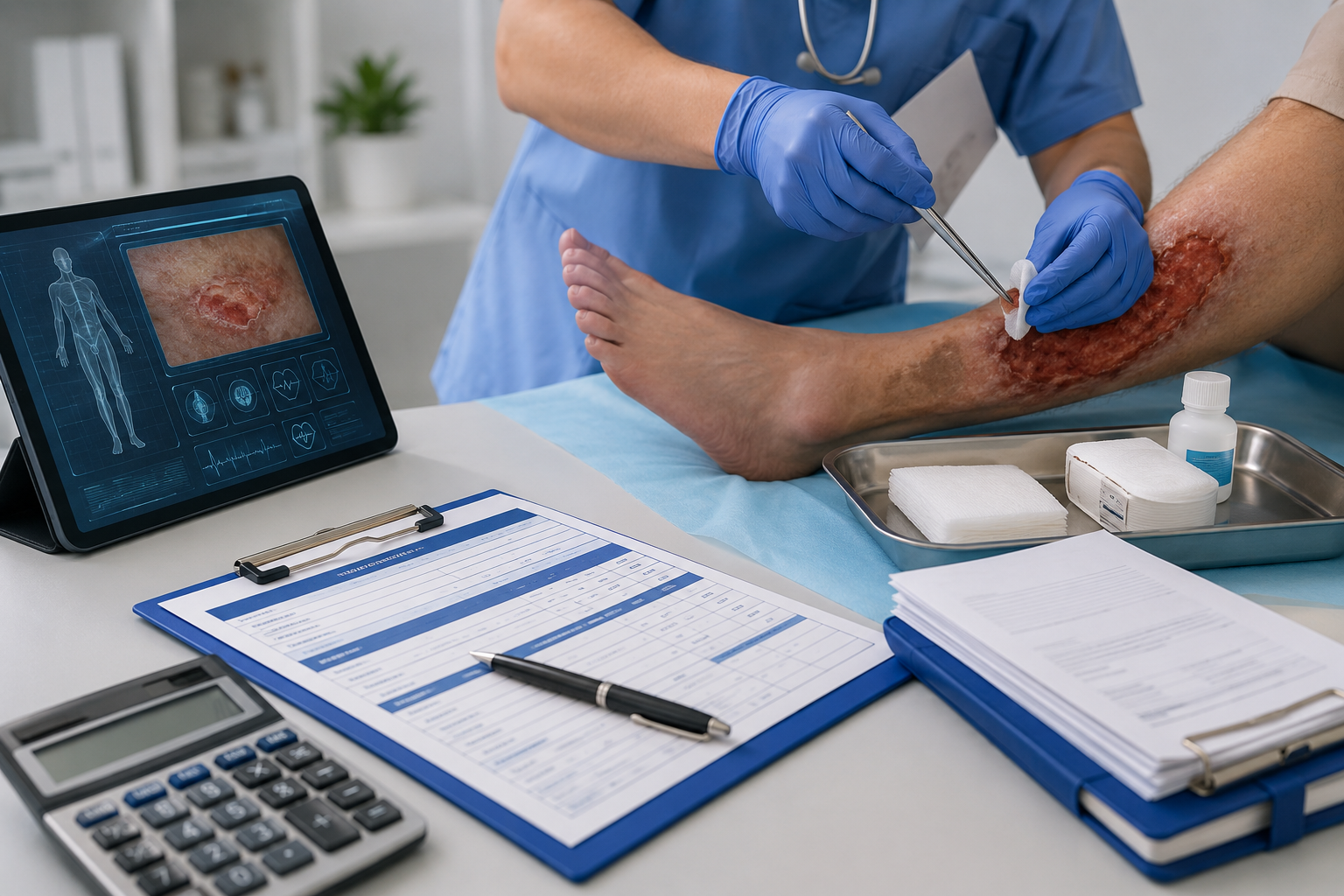
Master medical billing for CPT code 97598
Hey! Let us hang out and talk about the wild world of wound care management. Anyone who deals with medical billing on a daily basis knows that tracking down the right codes for skin procedures is an absolute puzzle.
One day you think you have your claims perfectly organized, and the next day a major insurance payer sends back a massive stack of rejections because a single surface area measurement was slightly off or because some materials were bundled incorrectly. Today, we are going to dive deep into a very specific add on line item that causes a ton of confusion if you do not understand the underlying pattern. We are focusing entirely on cpt code 97598, which is the essential code that billing teams use when clinicians are treating large, complex open wounds that need selective tissue debridement.
When it comes to medical billing for these advanced procedures, you cannot just type numbers into your clearinghouse software and hope for the best. You have to tell a highly accurate clinical story that any insurance auditor can easily verify. When a provider spends their time cleaning up an open ulcer, removing dead tissue, and prepping the area so it can actually heal, the documentation has to be completely flawless. Let us unpack how this code works, look at the actual clinical rules, and figure out how to submit clean claims without breaking a sweat.
What is the Big Deal About CPT Code 97598?
If you pull up the official cpt code 97598 description, you will find that it represents active wound care management for the selective debridement of open wounds. But here is the most important part of the puzzle: this code only kicks in for each additional 20 square centimeters, or a fraction thereof, after the clinician has already fully treated the initial 20 square centimeters. That means the cpt 97598 code is a classic add on code, meaning it can never stand alone on a claim form. It always needs its primary structural partner, which is CPT 97597.
Clinicians execute this service when they are performing selective debridement. This means they are using precise instruments like scalpels, surgical scissors, forceps, or even specialized high pressure waterjets to target and remove nonviable tissue, yellow slough, thick black eschar, or metabolic biofilm. The core goal of the provider is to leave all the healthy, living tissue completely intact while clearing away the dead cellular debris that actively stops a wound from closing up.
[Primary CPT 97597: First 20 cm²] ---> [Add-on CPT 97598: Each Additional 20 cm²]
When a specialist treats a massive pressure ulcer or a severe burn that spreads across a large portion of a limb, you will use the 97598 code to account for every extra block of space they cleared out. You cannot just count the number of individual wounds on the body; instead, you must calculate the total aggregate surface area that received this selective treatment during that specific patient encounter.
The Dressing Change Dilemma: Bundled vs Separate Billing
One of the single biggest financial traps in medical billing for outpatient wound care is knowing exactly when you can charge for bandages and when you just have to absorb the cost of materials. Let us clear up this massive point of confusion once and for all. You will constantly see billing clerks searching the system for a specific dressing change cpt code or trying to find a dedicated cpt code for wound dressing. Here is the honest truth that you need to know: standard, routine dressing changes are almost never paid separately when any form of debridement occurs.
When a healthcare provider finishes a selective debridement procedure under the umbrella of active cpt wound care codes, the physical act of applying a clean bandage, sterile gauze, or specialized topical medication to that site is considered an inherent part of the main procedure. The financial reimbursement value for the debridement code already includes the labor and materials for that final wrap. If you try to submit an extra cpt code for dressing change during that exact same encounter for that exact same wound, the insurance processor will instantly bundle the line item and deny the extra charge.
When Can a Dressing Service Stand on Its Own?
Now, let us look at the alternative scenario. If a patient schedules an appointment and comes into the clinic only to have their bandages swapped out, and absolutely no debridement or active tissue removal takes place, you cannot touch the 97598 code or the 97597 code. For those basic maintenance visits, the work is usually considered a fundamental part of a standard evaluation and management office visit, or it falls under non selective maintenance codes like 97602, which covers things like the application of wet to dry dressings.
There are a few instances where advanced multi layer compression systems like an Unna boot can be billed alongside active debridement, but you have to know the exact local coverage determinations and modifier rules established by your regional insurance payers to make those claims pass through automated system filters.
Mastering the Math: How to Calculate Units for 97598

Because the 97598 line item is billed in distinct size increments, your basic math skills have to be completely sharp. The provider chart notes must explicitly state both the length and the width of the debrided area in centimeters. You must multiply those two measurements together to find the total surface area in square centimeters.
Let us look at a functional unit breakdown table to see exactly how the billing units stack up based on the final size of the open wound area after the clinician finishes their selective debridement process.
| Total Debrided Wound Surface Area | Primary Code (97597) Units | Add-on Code (97598) Units |
|---|---|---|
| 12 square centimeters | 1 Unit | 0 Units |
| 20 square centimeters | 1 Unit | 0 Units |
| 22 square centimeters | 1 Unit | 1 Unit (covers the extra 2 cm²) |
| 40 square centimeters | 1 Unit | 1 Unit (covers the extra 20 cm²) |
| 45 square centimeters | 1 Unit | 2 Units (any fraction over triggers a unit) |
| 60 square centimeters | 1 Unit | 2 Units (covers the extra 40 cm²) |
| 61 square centimeters | 1 Unit | 3 Units (the extra 1 cm² requires a new unit) |
Export to Sheets
The phrase “or part thereof” within the official description is your absolute best friend when calculating these codes. If the total debrided surface area goes even one millimeter over a multiple of 20, you are legally required to round up to the next full unit of the add on code. Never round down out of habit, because doing that means your clinical practice is giving away valuable provider time, expertise, and expensive medical supplies for absolutely nothing.
Clinical Documentation that Safely Defends an Audit
If a commercial insurance company or a government payer decides to launch an audit on your wound care claims, they are going to read the provider progress notes with a massive magnifying glass. To establish true topical authority and safeguard your hard earned revenue, your clinical charts must present an airtight case for medical necessity. Simply typing a brief sentence like “wound was cleaned and a new dressing was applied” will result in an immediate financial clawback from the insurance company.
Critical Elements the Clinician Must Document
The clinical record needs to form a highly detailed, descriptive picture of the entire encounter. The medical billing specialist should look through the chart for these specific details before finalizing the claim submission:
- The exact anatomical location and description of the wound, such as a diabetic lateral foot ulcer or a chronic venous stasis lower leg ulcer.
- The exact pre debridement and post debridement dimensions of the wound area measured in centimeters.
- A clear, specific description of the nonviable tissue that was targeted, such as stringy yellow slough, thick avascular black eschar, or adherent biofilm.
- The exact professional tools utilized during the session, such as sharp iris scissors, a sterile curette, or a fine scalpel.
- The objective condition of the surrounding healthy skin tissue and a clear statement about the overall progress of the healing timeline.
If your office notes look like a generic, copy and pasted computer template with missing physical details, the insurance reviewer will immediately argue that the service rendered was just a basic cpt for wound dressing swap rather than an advanced active management procedure, dropping your reimbursement down to zero.
Avoiding the Dangerous Overlap with Surgical Debridement
Another huge spot where medical billing teams constantly run into trouble is confusing active wound care management with deeper, more invasive surgical debridement. The 97598 code series is specifically meant to represent superficial tissue removal that is limited to the epidermis and dermis layers of the skin.
If the clinical situation escalates and the provider has to cut deep into subcutaneous tissue, underlying muscle, fascial planes, or bone, you must abandon the 97597 and 97598 code series entirely. Deep tissue removal of that nature maps directly to the 11042 through 11047 surgical debridement code family.
[Epidermis and Dermis Tissue Only] --------> Bill 97597 and 97598
[Subcutaneous, Muscle, or Bone Layers] ---> Bill 11042 through 11047 series
Billing a 97598 unit when the provider actually had to excise necrotic muscle tissue is an example of undercoding, which cheats your medical practice out of legitimate, hard earned income. On the flip side, billing a heavy surgical code when the provider simply scraped away loose surface fibrin is a massive compliance infraction called upcoding, which can pull your business into severe regulatory penalties during a federal review.
Top Blunders that Lead to Instant 97598 Claim Denials

Let us take a look at some of the most frequent administrative blunders that cause these specific wound care claims to get kicked back by automated clearinghouses or manual insurance adjusters. Spotting these red flags early lets your billing team fix problems before they ever leave the building.
Missing the Primary Code Line
Because 97598 is strictly an add on code, it cannot legally exist on a CMS 1500 insurance claim form by itself. If an entry clerk accidentally inputs 97598 on a line item without placing 97597 directly above it, the insurance processing system will reject the file instantly. The primary code acts as the mandatory structural anchor that validates the existence of the add on line.
Mishandling the Evaluation and Management Overlap
If a clinician evaluates a brand new medical issue during the same calendar day visit as the wound debridement, you might need to bill a standard Evaluation and Management code alongside your active wound care codes. To execute this correctly, you must append Modifier 25 to the E/M code line. This tells the insurance software that the evaluation was a significant, separately identifiable service that went above and beyond the usual pre procedure prep. Without that modifier, the payer will assume the evaluation work was part of the debridement package and refuse to pay for the doctor time.
Ignoring Restricted Facility Settings
You must keep a very close eye on the physical place of service code listed on your claims. For example, Medicare maintains incredibly strict consolidated billing guidelines for patients residing in skilled nursing facilities. If a mobile provider performs a selective debridement under code 97598 for a patient who is currently in an active inpatient skilled nursing stay, Part B will reject the claim. In those institutional scenarios, the facility itself is financially responsible for the care, and your practice must seek direct payment from the building management rather than billing the government system.
Clear Cross References for Common Wound Procedures
| Clinical Service Provided | Correct CPT Code Mapping | Billing Unit Rule | Modifier Requirement |
|---|---|---|---|
| Selective debridement of skin up to 20 square centimeters | 97597 | First unit anchor line | No modifier needed if billed alone |
| Selective debridement of skin for each additional 20 square centimeters | 97598 | Add-on increment unit | Automatically links to the 97597 line |
| Deep surgical debridement down into subcutaneous tissue layers | 11042 | Based on depth, first 20 cm² | Replaces the 97597 skin series entirely |
| Non selective mechanical debridement like a wet to dry bandaging swap | 97602 | Per session billing | Cannot be combined with selective lines |
Export to Sheets
Keeping Communication Channels Wide Open with Providers
At the end of the day, achieving excellence in medical billing is completely rooted in internal office communication. Your billing and coding professionals must talk regularly with the physical therapists, podiatrists, and wound care nurses who are physically touching the patients. If you notice that a specific provider is constantly documenting massive wound sizes but completely forgetting to record the specific tools they used or the exact types of tissue they cut away, walk down the hall and have a quick, friendly conversation.
Show your clinical staff how adding just two or three descriptive words about their sharp instruments and tissue depth can completely protect the clinic from losing thousands of dollars during an outside insurance audit. When your entire healthcare team understands how their daily charting habits directly impact the financial health of the business, the whole system runs smoother, your clean claim rates skyrocket, and your clinic can focus entirely on what matters most: helping patients heal up and reclaim their lives.
Frequently Asked Questions
Can you ever report code 97598 as a standalone service on an insurance claim form?
No, you can never report code 97598 by itself. It is explicitly classified as an add on code by the American Medical Association, meaning it must always be linked to its primary base code, which is 97597, on the exact same date of service.
How do you handle billing if a provider treats two separate ulcers on opposite legs during the same visit?
You must calculate the total combined surface area of all wounds that received the exact same level of selective tissue debridement. You add the square centimeters together, then bill one unit of 97597 for the first 20 square centimeters, and use 97598 units for the remaining balance.
Is a separate modifier 59 required to link code 97598 to code 97597?
No, you do not need to attach modifier 59 to link 97598 to 97597. Because the payer computer systems already recognize 97598 as an official add on companion to 97597, they expect to see them grouped together without any separate styling modifiers.
What happens if the provider note states they washed the wound with saline but did not use tools?
If the provider only washed the wound with saline or wiped away loose drainage without actively removing stuck, dead tissue with tools, you cannot bill 97598. This simple cleaning does not meet the definition of selective debridement and would be bundled into a regular office visit code.
Do physical therapists have special rules when billing these wound care codes to Medicare?
Yes, when physical therapists bill these codes to Medicare, they must operate under a formal, physician certified plan of care. The documentation must clearly outline the ongoing medical necessity for the skilled tissue management, and the therapist must stay within their specific state licensure guidelines.