EGD CPT Code: A Practical Medical Billing Guide for Accurate Coding and Reimbursement
When working in medical billing, few things matter more than assigning the correct procedure code. One area that often creates confusion is the egd cpt code. Whether a provider performs a diagnostic examination, collects a biopsy, removes a lesion, or completes dilation during the procedure, selecting the right code directly affects claim accuracy and reimbursement.
EGD stands for esophagogastroduodenoscopy, a procedure commonly performed by gastroenterologists to examine the upper digestive tract. Medical billing teams regularly deal with documentation that includes multiple services performed during a single examination, making code selection more challenging than it may first appear.
Understanding the correct egd cpt code helps reduce denials, improve claim acceptance, and maintain compliance with payer requirements. This guide explains the most commonly used codes, documentation expectations, billing considerations, and coding scenarios that medical billing professionals encounter every day.
Understanding EGD in Medical Billing
Before discussing codes, it helps to understand what happens during the procedure.
An EGD allows a physician to examine:
- Esophagus
- Stomach
- Duodenum
The procedure is performed using a flexible endoscope inserted through the mouth. During the examination, additional services may be performed depending on findings.
These services can include:
- Diagnostic examination
- Tissue biopsy
- Foreign body removal
- Dilation of strictures
- Bleeding control
- Lesion removal
- Polyp removal
Each service may require a different CPT code.
What Is the EGD CPT Code?
The term cpt for egd refers to a family of CPT codes used to report upper gastrointestinal endoscopy procedures.
There is no single code that covers every EGD service.
Instead, the code depends on what was performed during the procedure.
Common EGD CPT Codes
| CPT Code | Description |
|---|---|
| 43235 | Diagnostic EGD |
| 43239 | EGD with biopsy |
| 43248 | EGD with guide wire insertion and dilation |
| 43249 | EGD with balloon dilation |
| 43247 | EGD with foreign body removal |
| 43251 | EGD with snare removal |
| 43255 | EGD with bleeding control |
| 43259 | EGD with endoscopic ultrasound |
Medical billing professionals should always review operative reports before selecting the final code.
43235 CPT Code Explained

One of the most searched codes in gastroenterology billing is the 43235 cpt code.
Code Description
| Code | Description |
| 43235 | Upper gastrointestinal endoscopy including esophagus, stomach, and duodenum with or without specimen collection by brushing or washing |
This code represents a purely diagnostic examination.
If the physician only visualizes the upper gastrointestinal tract and does not perform biopsy, lesion removal, dilation, or other therapeutic services, 43235 may be appropriate.
When to Use 43235
Common situations include:
- Evaluation of abdominal pain
- Investigation of GERD symptoms
- Nausea and vomiting assessment
- Dysphagia evaluation
- Upper gastrointestinal bleeding investigation
Documentation must support that no more extensive service was performed.
Esophagogastroduodenoscopy CPT Code Basics
The phrase esophagogastroduodenoscopy cpt code is simply the formal terminology used for EGD coding.
Medical billing teams often see this wording in:
- Operative reports
- Medical records
- Prior authorization requests
- Insurance correspondence
Although providers may use the full term, coding selection still depends on the exact service completed during the examination.
CPT Code for EGD With Biopsy
Biopsy is one of the most common additions to a diagnostic EGD.
CPT 43239
| Code | Description |
| 43239 | EGD with biopsy, single or multiple |
A common coding mistake occurs when billers report both 43235 and 43239.
Since biopsy includes the diagnostic examination, only 43239 is generally reported.
Documentation Requirements
Documentation should clearly indicate:
- Biopsy site
- Reason for biopsy
- Technique used
- Specimen submission details
Strong documentation supports accurate reimbursement and reduces audit risk.
EGD With Dilation CPT Code
Another frequently searched term is egd with dilation cpt code.
Dilation procedures are performed when narrowing of the esophagus affects swallowing or normal function.
Common Dilation Codes
| CPT Code | Description |
| 43248 | EGD with guide wire dilation |
| 43249 | EGD with balloon dilation |
The correct code depends on the dilation technique documented by the physician.
Why Documentation Matters
Medical billing specialists should confirm:
- Type of dilation performed
- Diameter achieved
- Equipment used
- Clinical indication
Payers may request records during claim review.
CPT Code EGD and Medical Necessity
Correct coding alone does not guarantee payment.
Insurance carriers also evaluate medical necessity.
Common diagnosis indications include:
- Dysphagia
- GERD
- Gastrointestinal bleeding
- Barrett esophagus
- Gastric ulcer
- Duodenal ulcer
- Anemia
- Chronic abdominal pain
The diagnosis code must support the procedure performed.
EGD CPT Codes and Reimbursement

Accurate reimbursement depends on several factors.
Key Elements
| Factor | Impact |
| Correct CPT selection | Determines procedure payment |
| ICD diagnosis support | Demonstrates medical necessity |
| Modifier usage | Clarifies circumstances |
| Provider documentation | Supports claim validity |
| Payer policy | Determines reimbursement rules |
Even a small coding error can result in denial or payment reduction.
Common Billing Mistakes With EGD Coding
Medical billing teams frequently encounter avoidable coding issues.
Reporting Diagnostic and Therapeutic Codes Together
When a therapeutic service is performed, the diagnostic service is usually included.
Missing Documentation
Incomplete records often trigger payer requests.
Incorrect Modifier Usage
Modifiers should only be applied when supported by documentation and payer guidelines.
Selecting a Lower Complexity Code
Under coding may reduce reimbursement and create compliance concerns.
Selecting a Higher Complexity Code
Over coding increases audit exposure and denial risk.
Documentation Tips for Medical Billing Teams
Good documentation is the foundation of accurate coding.
Billers should verify that reports contain:
| Documentation Element | Importance |
| Procedure indication | Supports medical necessity |
| Findings | Supports service level |
| Technique performed | Determines CPT code |
| Biopsy details | Supports pathology billing |
| Dilation details | Supports therapeutic coding |
| Physician signature | Compliance requirement |
Missing information should be clarified before claim submission.
How Medical Billing Professionals Can Reduce EGD Claim Denials
Claim denials often result from documentation gaps rather than coding errors.
Several strategies help improve success rates.
Review Operative Reports Carefully
Never code based solely on scheduling notes.
Verify Diagnosis Support
The diagnosis should justify the service performed.
Monitor Payer Policies
Requirements may vary between commercial payers and government programs.
Conduct Internal Audits
Periodic reviews help identify coding trends and training opportunities.
Maintain Coding Education
Coding updates occur regularly, making ongoing education important.
Difference Between Diagnostic and Therapeutic EGD
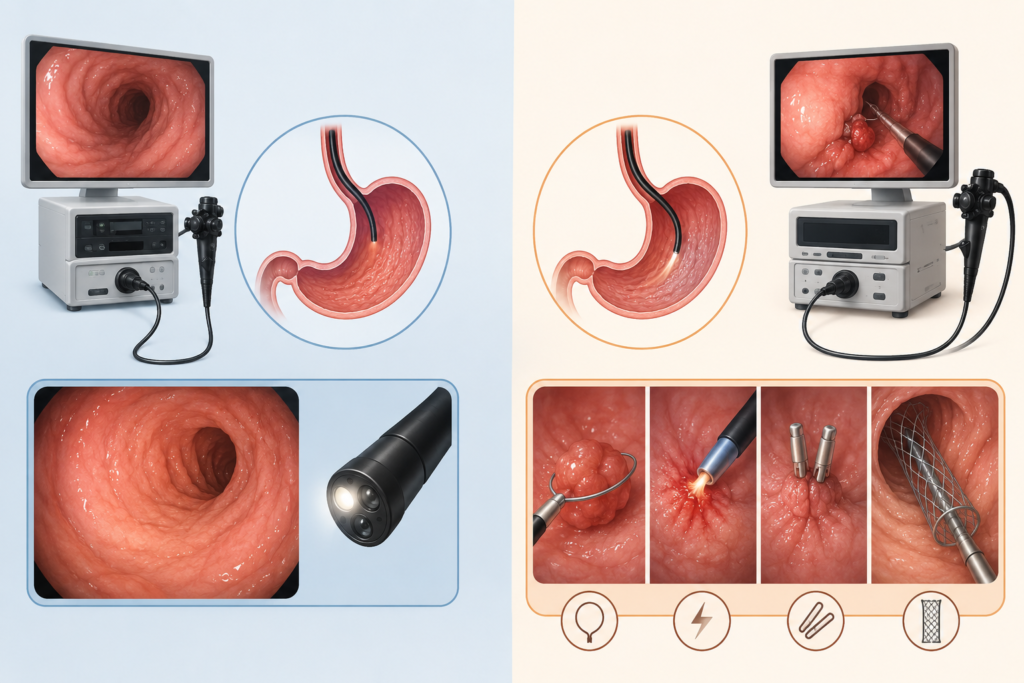
Understanding this distinction improves coding accuracy.
| Diagnostic EGD | Therapeutic EGD |
| Visual examination | Treatment performed |
| Usually reported with 43235 | Reported with procedure specific codes |
| Lower complexity | Higher complexity |
| No intervention | Includes intervention |
Therapeutic services generally replace the diagnostic code because the examination is considered part of the procedure.
Choosing the Correct CPT Code for EGD
When reviewing documentation, billers can follow a simple workflow.
Step 1
Confirm an EGD was performed.
Step 2
Identify all interventions documented.
Step 3
Determine whether biopsy, dilation, removal, or bleeding control occurred.
Step 4
Select the most accurate CPT code.
Step 5
Verify diagnosis support and payer requirements.
This process helps improve coding consistency across claims.
Why EGD Coding Matters in Medical Billing
Accurate coding affects more than reimbursement.
It also influences:
- Revenue cycle performance
- Compliance outcomes
- Audit readiness
- Provider productivity metrics
- Insurance claim acceptance rates
Healthcare organizations that invest in coding accuracy often experience fewer denials and stronger financial performance.
Final Thoughts
The world of egd cpt codes can seem complicated because many procedures begin as a simple diagnostic examination but quickly become therapeutic interventions. For medical billing professionals, success comes from understanding procedure documentation, identifying the exact service performed, and selecting the correct code based on physician records.
Whether dealing with the 43235 cpt code, reviewing an egd with dilation cpt code, or determining the appropriate cpt code for egd with biopsy, careful documentation review remains the most important step. Consistent coding practices help reduce denials, support compliance, and improve reimbursement outcomes.
Medical billing teams that stay informed about coding guidelines and payer expectations are better positioned to maintain accuracy and protect revenue across gastroenterology claims.
Frequently Asked Questions
1. What is the most common EGD CPT code?
The most commonly used code is 43235, which represents a diagnostic upper gastrointestinal endoscopy without therapeutic intervention.
2. Can 43235 and 43239 be billed together?
Generally no. When a biopsy is performed, 43239 includes the diagnostic examination and is usually reported alone.
3. What is the correct EGD with dilation CPT code?
The most common dilation codes are 43248 and 43249. The correct selection depends on the dilation method documented by the physician.
4. What does CPT for EGD mean?
CPT for EGD refers to the Current Procedural Terminology code assigned to an upper gastrointestinal endoscopy procedure.
5. Why are EGD claims denied?
Common reasons include insufficient documentation, incorrect code selection, unsupported diagnosis codes, and payer specific billing requirements.